


I’ve always been a fairly black-and-white person. When I commit to something, I tend to go all in. Moderation has never come particularly naturally to me, and I have a long history of taking what should be relatively straightforward interests and turning them into considerably larger projects.
When I decided to get serious about working out, I didn’t buy a couple of weights and call it a day. I outfitted my garage with an entire Rogue setup. When I became interested in woodworking, I accumulated just about every tool I could reasonably justify buying, then built a custom workbench complete with a folding router table, miter station, integrated measurement tracks, dog holes, a vise, and storage, all sitting on 9.5-inch casters.
Even moving into my college dorm became an engineering project. While everyone else was figuring out where to put their mini fridge, I was installing a surround sound system powerful enough to knock out the electricity in the building – which my family never lets me forget.
This tendency has served me extraordinarily well, both personally and professionally. But I’ve also learned that my definition of getting something right isn’t always the same as what the situation actually requires.
Years ago, while I was building Screen6, my boss, David De Jong (DDJ), gave me a piece of feedback that’s stuck with me. He told me that the quality of my work, and the standard I held myself to, were so far above what was expected that my 80% was typically more than someone else’s 100%.
His point was that I needed to ship things faster.
He wasn’t asking me to lower my standards. He was pointing out that the incremental effort I was investing to take something from my version of 80 to 100 wasn’t necessarily creating equivalent value.
It’s advice I’ve thought about often, although I can’t say I’ve always been particularly good at following it.
I was reminded of that conversation during my commute this morning, when three completely unrelated podcasts somehow ended up making variations of the same argument.
The Cost of Going All In
The first was an episode of Money Rehab, where Nicole Lapin and Anthony O’Neal were debating whether spending $28 on a sandwich was a financially irresponsible decision.
Kevin O’Leary had apparently told Nicole that nothing tastes as good as compounding feels. It’s a good line, and from a purely mathematical perspective, he’s not wrong.
Nicole took a different position. If you’ve eliminated your consumer debt, established an emergency fund, and are maximizing your retirement contributions, there’s nothing particularly irresponsible about buying yourself an expensive sandwich.
Anthony generally sided with O’Leary on the math. But Nicole’s argument extended well beyond the sandwich.
She described years of extreme dieting, where she’d eliminate virtually everything she enjoyed eating in pursuit of some ideal outcome. Eventually, that deprivation would catch up with her, usually in the form of standing alone in her kitchen at midnight eating an enormous piece of chocolate cake.
Her observation was that allowing herself something as small as a Hershey’s Kiss along the way might have prevented the eventual overcorrection.
The same principle applies to spending. You can build a financial plan that accounts for the occasional indulgence, or you can attempt to eliminate every unnecessary expense in pursuit of maximizing your savings.
Both approaches involve discipline, but there’s value in enjoying the money you’re working so hard to accumulate.
I can relate to Nicole’s tendency to take things to extremes. In what might have been my most stereotypical tech bro moment, I spent months drinking Soylent, having convinced myself that eating was an inefficiency to be solved. On another occasion, I showed up to a partner dinner at a steakhouse carrying my own juice because I was in the middle of a cleanse. Nothing says business development quite like watching everyone else enjoy a ribeye while you sip vegetables through a straw.
I’d optimized eating for efficiency while overlooking one of the main reasons we eat in the first place: enjoyment.
The Last 20%
Next was Scott Galloway and Oliver Burkeman discussing our obsession with optimization.
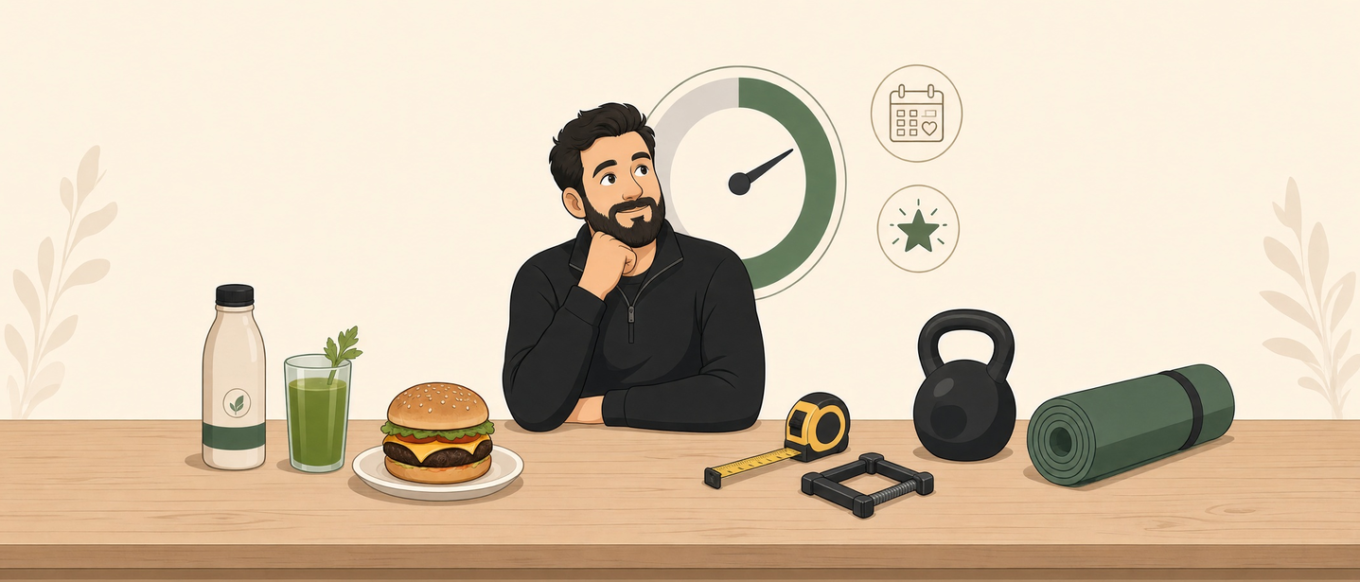
Scott described a scale from zero to 100. At zero, you’re on the couch eating Twinkies. At 100, you’re Bryan Johnson, spending millions optimizing every biological function. Scott prefers to live at 80. He eats well, exercises consistently, and takes his health seriously, while leaving room for the occasional late night, missed workout, or indulgent meal. The last 20 points simply cost more than they’re worth.
Oliver introduced a concept borrowed from Dan Harris that I particularly liked: daily-ish. The idea that consistency matters more than perfection, and missing a day doesn’t undo the value of showing up the rest of the week.
In college, I got so into hot yoga that I was attending a 5:30 a.m. class and returning for another session that evening. Apparently, once a day wasn’t enough.
Listening to Scott, I thought back to DDJ’s feedback. The additional effort required to get from 80 to 100 doesn’t always create equivalent value. Sometimes you’re better off shipping sooner, getting feedback earlier, or putting that effort toward something else.
The Aspirational Self
The final podcast was Auren Hoffman’s Summation, featuring Noah Glass, founder and CEO of Olo, who shared some interesting observations from more than two decades of restaurant ordering data.
Our eating habits follow a remarkably predictable pattern. Mondays and Tuesdays are salads and smoothies. By Friday and Saturday, it’s burgers, burritos, and pizza. The best days for salad chains are Mondays in January, while their worst tend to fall on weekends in November and December.
But another observation caught my attention. Olo allows customers to save their favorite orders, and people disproportionately save healthier meals, despite ordering indulgent food far more frequently. They’re planning for the person they aspire to be, while their actual orders tell a different story.
I see this constantly in advertising, where declared preferences and observed behavior don’t always align. I joke about it on calls all the time. When a form asks me to describe my body type, I still check “athletic build.” At some point, the data should probably be allowed to challenge my self-assessment.
The favorites list represents our intentions. The order history reflects our actual behavior.
And apparently, we’re all a little more aspirational on Monday than we are on Friday.
Knowing When to Stop
What struck me during that morning’s commute was how closely these three conversations aligned, despite coming from completely different perspectives.
All three brought me back to DDJ’s advice.
I’ve always believed that if something is worth doing, it’s worth doing exceptionally well. That mentality has served me throughout my career, and I have no intention of abandoning it. But there’s a meaningful distinction between producing the best possible work and creating the best possible outcome.
Sometimes that means shipping a product before every detail has been addressed, because feedback from actual customers is often more valuable than another round of optimization in isolation. Sometimes it means recognizing that another hour of effort would be better invested elsewhere. And sometimes it means ordering the $28 sandwich because you’ve already done the work to put yourself in a position to enjoy it.
What these conversations reinforced for me is that discipline and optimization should serve a purpose, and more effort doesn’t always produce a better result.
DDJ was right that my 80% was often more than enough. The challenge is recognizing when that’s true, and having the confidence to redirect the remaining effort toward the next challenge.
Which brings me back to Noah’s restaurant data.
We all have a favorites list, an aspirational version of ourselves and the priorities we believe we hold. But our order history tells a more accurate story about where we actually invest our time, attention, and energy.
Perhaps the better question isn’t how to get everything to 100, but which things genuinely deserve it.